
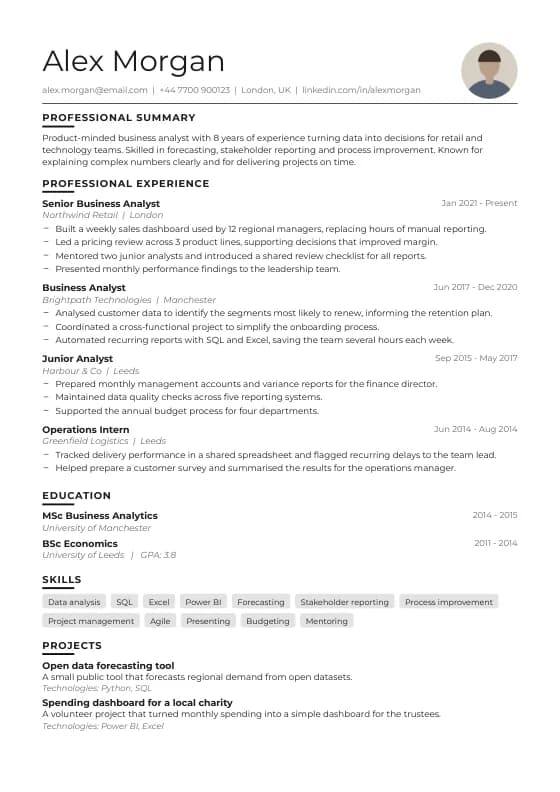
Designer
An oversized name, hairline rule and quiet colour.
Best for: UX, Graphic design, Art direction
ATS goodUse this template
UX hiring managers read your resume to decide whether to open your portfolio. So the resume must signal the products you designed, your process, the research you ran and the outcomes of your work, with a clear portfolio link.
Paste a ux designer job posting and get a tailored resume in about 30 seconds.
Tailor my resume freeThese are illustrative. Swap in your own real details, keep it to three or four lines, and make every claim one you can back up.
Product designer
UX designer with four years designing a SaaS dashboard used by 10,000 customers. Lead research, prototyping and testing in Figma, and contributed to a design system that cut design-to-dev handover time. Increased task completion on the core workflow from 68% to 84%.
Junior designer
UX designer with a bootcamp background and two shipped projects. Strong in user interviews, wireframing and usability testing, with a focus on accessibility and clear interfaces. Portfolio linked below.
UX Designer
Example Software · Apr 2021 to present
A sample only. The figures are illustrative, so replace them with your own real ones and never copy numbers you cannot support.
Only list skills you genuinely have, and put the ones the job posting asks for first.
Requirements and names differ by country and employer. List only what you actually hold, with the year or expiry where relevant.
For UX roles, the portfolio does the heavy lifting and the resume gets you there. Reviewers often scan for ten seconds, then open the link. Put it directly under your name, make sure it loads quickly, and lead it with two or three case studies close to the company’s product.
The resume should still stand alone. It should state the products you designed, the users they served, the team you worked with and your role. A product designer in a team of five different from a solo designer in a small agency, and the reader needs that context.
Hiring teams look for a clear process: research, definition, ideation, prototyping, testing, iteration and handoff. Show where you contributed, from running interviews to building flows in Figma to working with engineers on implementation. Include methods that suit the role, such as usability testing, card sorting or journey mapping.
Outcomes distinguish designers from decorators. Report task success, conversion, drop-off, support requests or satisfaction scores before and after your work, even if the sample was small. If you cannot share numbers because of confidentiality, describe the change qualitatively and be honest about what you can and cannot claim.
Design systems and accessibility are valued. Mention components you built, documentation you wrote and standards you followed, and how you worked with engineers to keep implementation faithful.
Finally, collaboration. UX designers influence product decisions, so show how you worked with product managers, engineers and researchers. Keep the resume clean and visually considered but readable by software, with real text and standard headings.
Use the exact wording from the job description where it is true for you. These terms come up often in this field:
Start with a strong verb, say what you did, and finish with the result. Fill in your real numbers. If you do not have a number, describe what changed instead.
Want to see how well your CV matches a posting? Try the free ATS resume checker, or let the CV optimizer do the rewriting for you.
One page with a clear portfolio link at the top. Tasteful design is fine, but use real text and standard headings so software can parse it.
Share a short story about a design problem you solved, how you validated it and what changed for users. Need a starting point? The cover letter generator writes a draft from your CV and the job posting.
An oversized name, hairline rule and quiet colour.
Best for: UX, Graphic design, Art direction
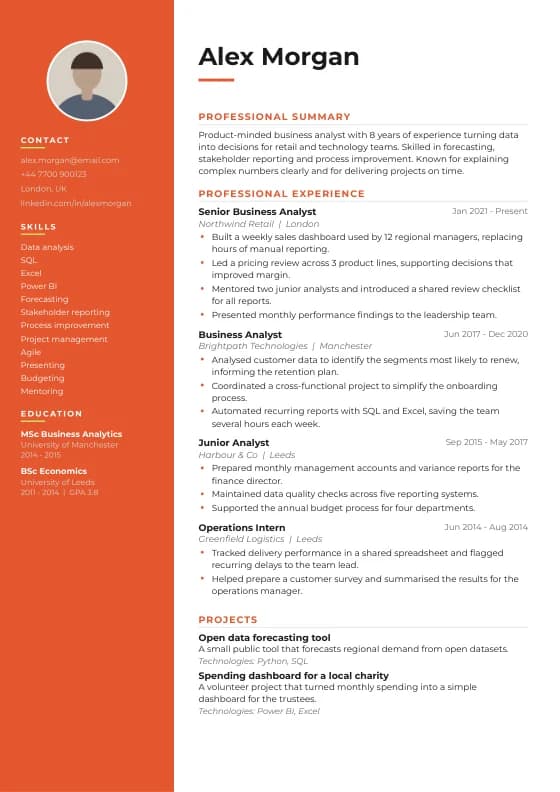
A bold coral sidebar with room for your photo.
Best for: Design, Brand, Photography
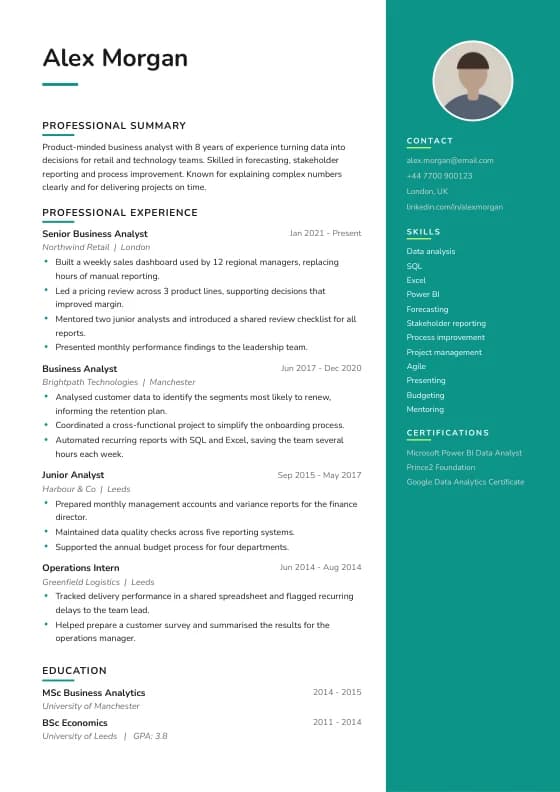
Teal right-hand sidebar with a photo and rounded Nunito type.
Best for: Creatives, Teaching, Events
Portfolio link, projects with outcomes, process and research, tools, design systems and collaboration.
Use task success, conversion, satisfaction, support volume or time saved, with before and after numbers when available.
Not always. Strong portfolios matter more, but list your education and courses.
A tasteful design helps, but readability and clean text come first.
One page, with the portfolio link directly under your name. The resume exists to get your portfolio opened, so keep it short and let the case studies carry the detail.
Two or three strong case studies beat a long gallery. Pick the ones closest to the company's product and make sure each shows the problem, your role, the process and the result.
Say what you actually ran: the number of interviews, how you recruited participants, how you synthesised notes and what changed in the design as a result. Honest, small studies read better than inflated claims.