
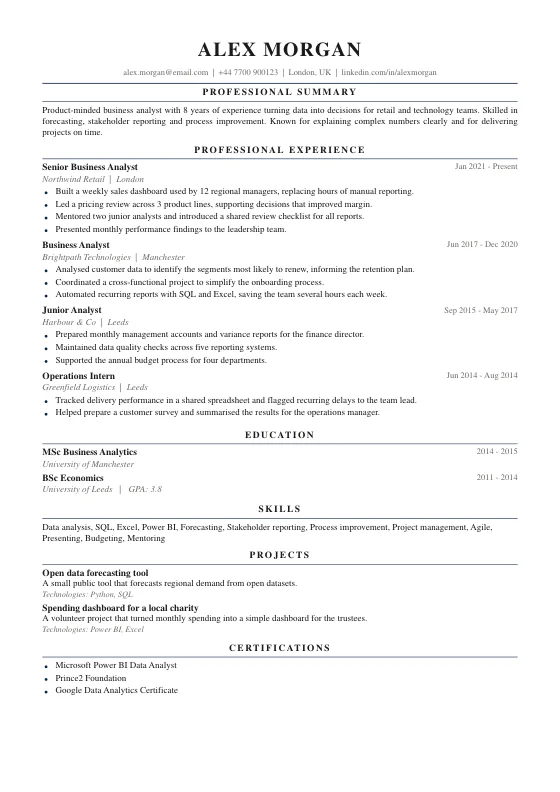
Finance
Dense, conservative and navy. Built for banking and accounting.
Best for: Banking, Accounting, Audit
ATS excellentUse this template
Small businesses and accounting firms hire bookkeepers who keep books accurate and on time. Your resume should name the software you use, the volume of transactions you handle and the close, payroll or VAT processes you run.
Paste a bookkeeper job posting and get a tailored resume in about 30 seconds.
Tailor my resume freeThese are illustrative. Swap in your own real details, keep it to three or four lines, and make every claim one you can back up.
In-house bookkeeper
Detail-oriented bookkeeper with five years managing the books for a 30-person company. Handle AP/AR, bank reconciliations, payroll inputs and monthly close in Xero, and prepare clean packs for the external accountant.
Practice bookkeeper
Bookkeeper with three years in an accounting practice, managing 25+ small-business client files. Skilled in VAT returns, reconciliations and management reports, with strong client communication.
Bookkeeper
Example Services Ltd · Mar 2020 to present
A sample only. The figures are illustrative, so replace them with your own real ones and never copy numbers you cannot support.
Only list skills you genuinely have, and put the ones the job posting asks for first.
Requirements and names differ by country and employer. List only what you actually hold, with the year or expiry where relevant.
A business owner wants books they can trust and a bookkeeper who tells them what is happening before problems grow. An accountant wants clean, complete records at year end. Both read your resume looking for software, scope and reliability, and both are alarmed by vagueness, since the work is all about precision.
Scope separates levels. Entering invoices is different from reconciling accounts, preparing tax returns, running payroll and producing management reports. State exactly what you were responsible for, and what you were not, so the reader can place you accurately.
Name the packages you use daily, such as Xero, QuickBooks or Sage, and what you do within them: bank feeds, invoicing, payroll inputs, VAT or sales tax reports. Employers often prefer someone who already knows their system, so a match to the posting is a real advantage.
Volume and cadence add credibility. Mention how many invoices, transactions or client files you manage, and your monthly cycle: reconciliations by the fifth working day, management accounts by the tenth. If you improved a process, such as automating bank rules or cutting overdue receivables, state the effect.
Compliance is a major part of the job. If you prepared and filed VAT or sales tax returns, payroll submissions or year-end packs, say so, along with the fact that deadlines were met. Penalty-free records are a strong signal of reliability.
Because bookkeepers see sensitive financial information, confidentiality counts. Mention it, and mention how you work with accountants and owners. A tidy one-page resume with software, scope and a few specific results is usually enough, and it should itself be free of numerical or formatting errors.
Use the exact wording from the job description where it is true for you. These terms come up often in this field:
Start with a strong verb, say what you did, and finish with the result. Fill in your real numbers. If you do not have a number, describe what changed instead.
Want to see how well your CV matches a posting? Try the free ATS resume checker, or let the CV optimizer do the rewriting for you.
One page, tidy and conservative. Skills block with software, then experience.
Mention the type of business, your software and one example of improving accuracy or close speed. Need a starting point? The cover letter generator writes a draft from your CV and the job posting.
Dense, conservative and navy. Built for banking and accounting.
Best for: Banking, Accounting, Audit
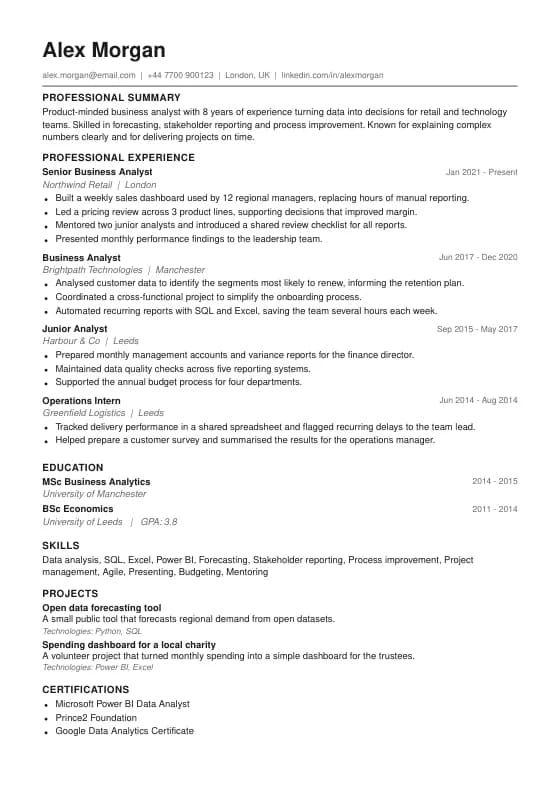
Plain single column that every applicant tracking system reads cleanly.
Best for: Any role, Online portals
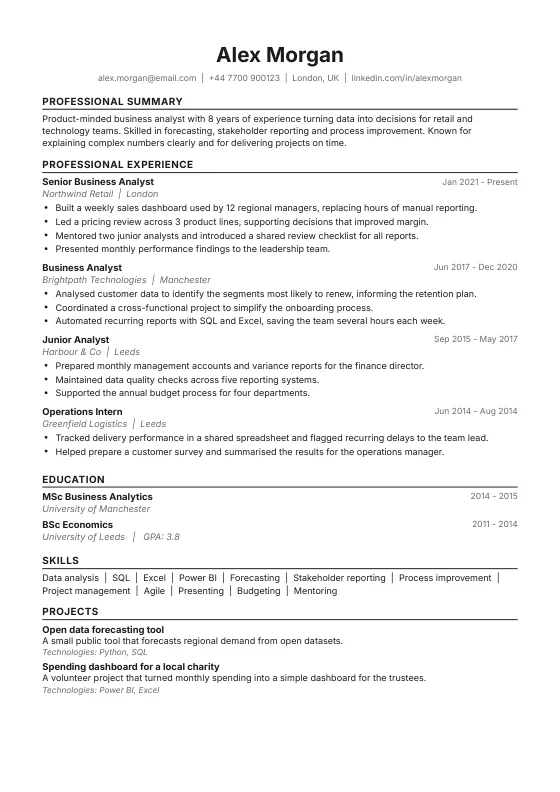
Centred header with ruled sections. Neutral and parser-safe.
Best for: Any role, Corporate
Accounting software, AP/AR, reconciliations, payroll, tax returns, month-end close and Excel.
Often helpful but not always required. List your qualification and software certifications.
Mention reconciled accounts, audits passed, error-free returns or clean accountant feedback.
Use admin, retail cash handling or coursework. Show software skills and attention to detail.
One page is usually enough. Put the accounting software and the scope of your work (AP, AR, payroll, VAT) high on the page, and move older unrelated jobs into a single line.
Name the package and how you use it, such as Xero for bank feeds and reconciliations or QuickBooks for payroll inputs. Versions rarely matter; scope does.
Give the cycle and the result: month-end close within a set number of working days, VAT or sales tax returns filed on time with no penalties, or payroll run without errors for a stated period.