
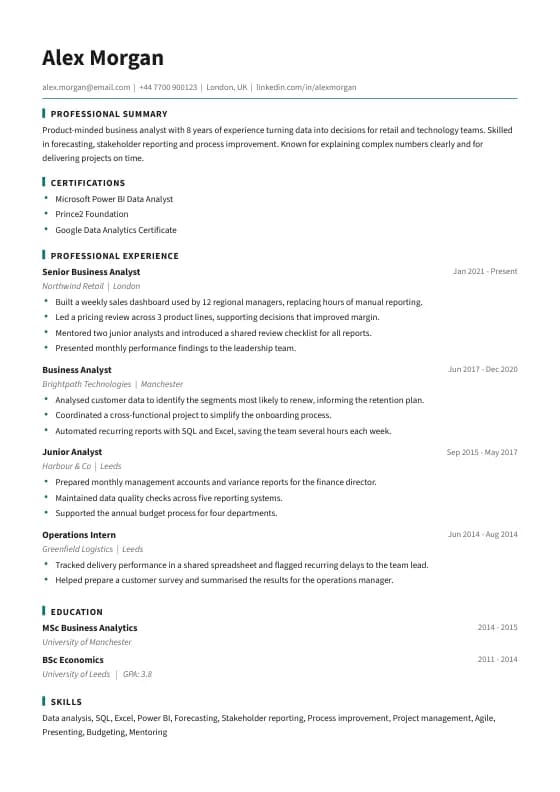
Clinical
Certifications up top. Calm teal for healthcare roles.
Best for: Nursing, Medicine, Allied health
ATS excellentUse this template
Practice managers hire medical assistants who can do both clinical and administrative work without drama. The resume that stands out shows patient volume, the procedures you assist with, the record systems you use and the confidentiality you maintain.
Paste a medical assistant job posting and get a tailored resume in about 30 seconds.
Tailor my resume freeThese are illustrative. Swap in your own real details, keep it to three or four lines, and make every claim one you can back up.
Clinical focus
Certified medical assistant with four years in a busy family practice supporting three physicians and about 40 patients a day. Skilled in vitals, venipuncture, ECGs and preparing patients for exams, with accurate charting in the practice EHR.
Front and back office
Versatile medical assistant balancing patient intake, scheduling and clinical support in an outpatient clinic. Confident with insurance verification, referrals and phlebotomy, and known for putting nervous patients at ease.
Medical Assistant
Example Family Clinic · Jun 2021 to present
A sample only. The figures are illustrative, so replace them with your own real ones and never copy numbers you cannot support.
Only list skills you genuinely have, and put the ones the job posting asks for first.
Requirements and names differ by country and employer. List only what you actually hold, with the year or expiry where relevant.
Practice managers hiring medical assistants need someone who is safe clinically, quick administratively and kind to patients. In the first scan they look for your credential, the specialty you have worked in, the number of patients you handle and the records system you use. These four facts tell them how long you will take to become useful, which is the real question behind every clinic hire.
Specialty affects how your resume is read. A paediatric clinic is looking for gentleness with children and parents, a cardiology practice for ECG experience, a dermatology office for procedure assistance and patient education, and an urgent care for pace. Look at the clinic’s website, then reorder your skills so the closest match comes first.
The role is a hybrid, and employers want both halves proven. On the clinical side, list the tasks you perform without being asked: taking vitals, preparing patients, drawing blood, performing electrocardiograms, running point-of-care tests, sterilising instruments and assisting minor procedures. Always make clear that you work within your scope and under supervision.
On the administrative side, include scheduling, referrals, insurance or payer verification, phone triage, records updates and prior authorisations if relevant. Naming the electronic health record you use matters, because systems differ and training takes time. If you have helped reduce no-shows or waiting time, say how.
Patient privacy is a hiring criterion. Mention data protection or privacy training and the habits that go with it, such as verifying identity before sharing information and handling records securely. Never include any patient details on the resume itself.
Many medical assistants use the role as a stepping stone to nursing or other health careers, and employers do not mind, as long as you can show commitment to the job in front of you. Include relevant certifications with dates, mention any bilingual ability for multilingual communities, and keep the document to one clean page that looks as organised as the clinic wants its records to be.
Use the exact wording from the job description where it is true for you. These terms come up often in this field:
Start with a strong verb, say what you did, and finish with the result. Fill in your real numbers. If you do not have a number, describe what changed instead.
Want to see how well your CV matches a posting? Try the free ATS resume checker, or let the CV optimizer do the rewriting for you.
One page for most medical assistants. Put certifications in a visible block near the top, then summary and experience. Keep a plain, single-column layout.
Mention the specialty, one thing you like about the practice, and an example of calming an anxious patient or keeping accurate charts on a busy day. Need a starting point? The cover letter generator writes a draft from your CV and the job posting.
Certifications up top. Calm teal for healthcare roles.
Best for: Nursing, Medicine, Allied health
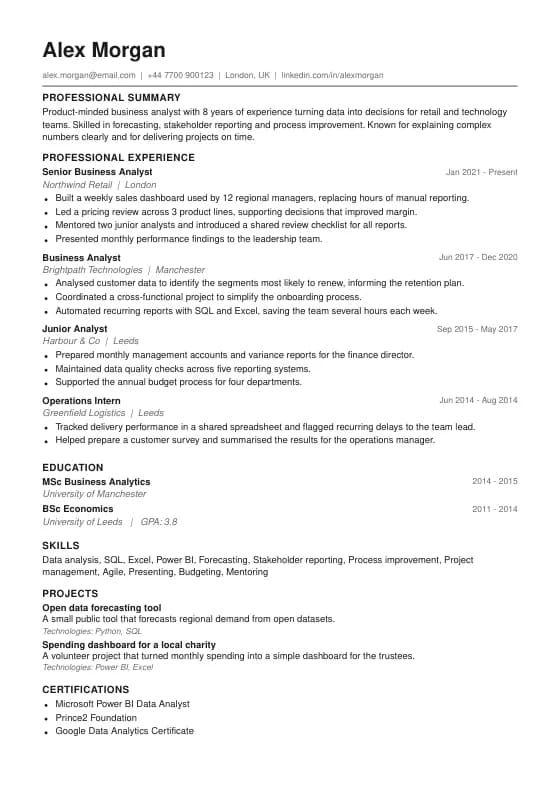
Plain single column that every applicant tracking system reads cleanly.
Best for: Any role, Online portals
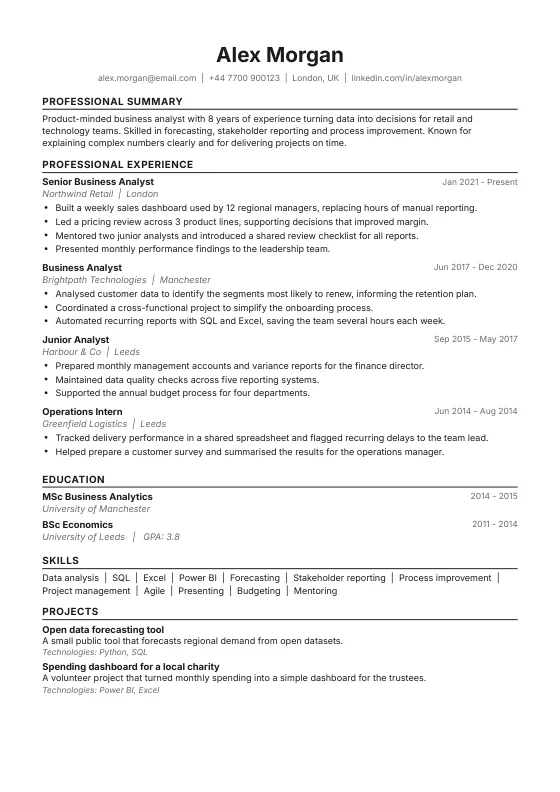
Centred header with ruled sections. Neutral and parser-safe.
Best for: Any role, Corporate
Certifications, clinical skills, administrative skills, EHR systems, patient volume and any specialty experience.
In many places employers prefer or require one. List it clearly, with the issuing body and validity.
Use clinical placements, externships, volunteering and relevant admin or customer service work. Highlight training and certification.
Yes, or the local equivalent. It signals that you handle patient data properly.
One page for almost everyone. Put certifications, clinical skills and your EHR system where a practice manager will see them first, and trim older, unrelated jobs.
Pull out the procedures and patient groups closest to the specialty, such as ECGs for cardiology or gentle handling for paediatrics, and put them first. Keep the administrative skills in a short second block.
Yes. A line about training in patient data protection signals that you can be trusted with records, which practices check carefully.