
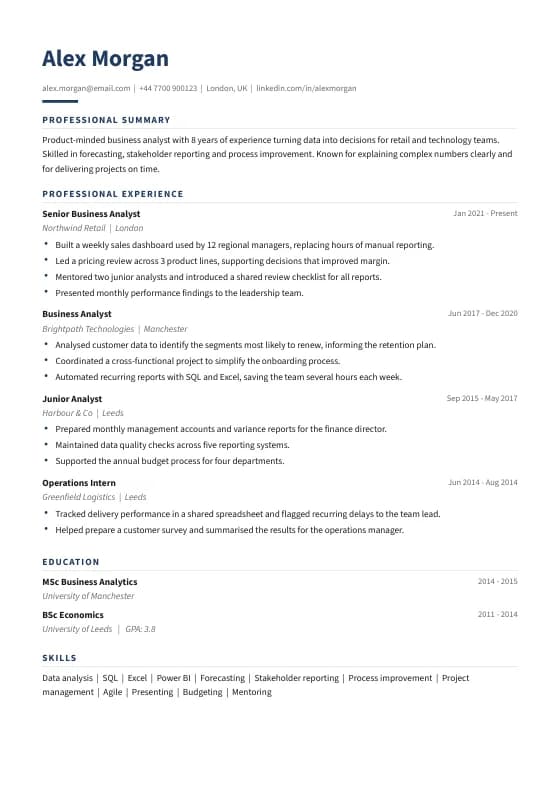
Consultant
Crisp accent headings with a pipe-separated skills line.
Best for: Consulting, Strategy, Project management
ATS excellentUse this template
Business analyst roles sit between the business and technology teams. A strong resume proves you can gather requirements, analyse data, model processes and deliver measurable improvements, using the tools and methods the company expects.
Paste a business analyst job posting and get a tailored resume in about 30 seconds.
Tailor my resume freeThese are illustrative. Swap in your own real details, keep it to three or four lines, and make every claim one you can back up.
Process-focused
Business analyst with five years in financial services, mapping processes, writing requirements and supporting system migrations. Reduced manual reconciliation time by 35% by redesigning a workflow and working with developers on automation. Skilled in SQL and Power BI.
Data-focused
Business analyst combining stakeholder workshops with SQL and dashboards. Translate questions into data, support decision-making and track KPIs for operations and sales teams.
Business Analyst
Example Bank · Jun 2020 to present
A sample only. The figures are illustrative, so replace them with your own real ones and never copy numbers you cannot support.
Only list skills you genuinely have, and put the ones the job posting asks for first.
Requirements and names differ by country and employer. List only what you actually hold, with the year or expiry where relevant.
Business analysts sit between people who know what the business needs and people who can build it. Hiring managers look for evidence that you can listen, structure ambiguity and write requirements that both sides understand. They also look for domain knowledge, since a bank analyst and a retail analyst face very different problems.
Show the type of project: system implementation, process redesign, regulatory change, data migration or reporting. Include the size, the stakeholders and the methodology, whether agile, waterfall or hybrid.
Name your deliverables: business requirements, functional specifications, user stories with acceptance criteria, process maps, data dictionaries, test cases and UAT reports. Specific artefacts convince better than the word documentation.
Pair each deliverable with an outcome. A process map that revealed duplicate steps, a requirements workshop that resolved a long-running disagreement, or a dashboard that replaced a manual report all demonstrate business value. Quantify time or cost saved where you can.
Most analyst roles now expect comfort with data. List SQL, Excel, and the BI tools you use, along with what you did with them, such as validating data, building dashboards or analysing trends for decisions.
Stakeholder management is the other half. Describe how you ran workshops, handled conflicting priorities and kept projects on track. Add relevant certifications, keep the resume to one or two pages, and use the language of the job posting where it truthfully matches your experience.
Use the exact wording from the job description where it is true for you. These terms come up often in this field:
Start with a strong verb, say what you did, and finish with the result. Fill in your real numbers. If you do not have a number, describe what changed instead.
Want to see how well your CV matches a posting? Try the free ATS resume checker, or let the CV optimizer do the rewriting for you.
One to two pages. A short summary, a skills block and impact-led experience. Keep the layout clean.
Connect a problem in the company's domain to a similar problem you solved, with the method and result. Need a starting point? The cover letter generator writes a draft from your CV and the job posting.
Crisp accent headings with a pipe-separated skills line.
Best for: Consulting, Strategy, Project management
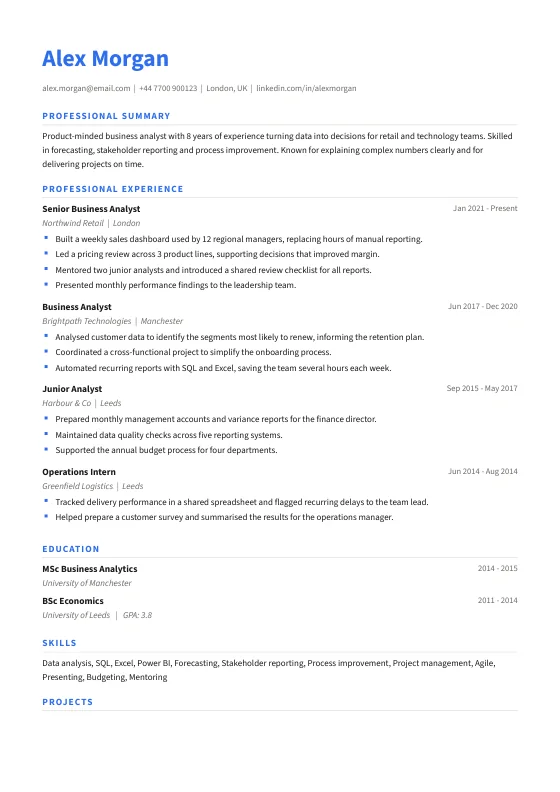
A fresher look with accent headings, still one clean column.
Best for: Tech, Marketing, Operations
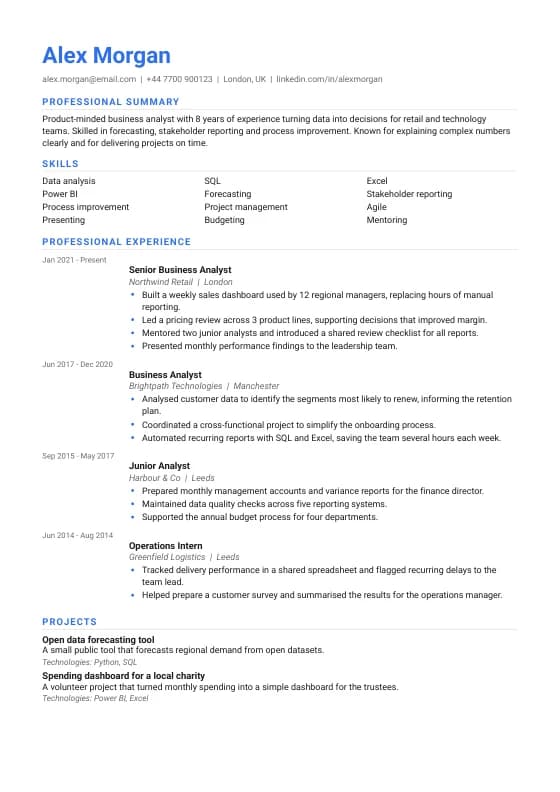
Dates in the margin, skill columns and projects up front.
Best for: Data science, Analytics, Research
Requirements work, process improvements, data skills, tools, methods and measurable results.
Not required, but CBAP or similar helps. List certifications with year.
Use project, operations or analyst experience, show process and data work, and add relevant training.
Yes. Mention how you use it, not just that you know it.
One to two pages. A single page suits fewer than five years; beyond that, use a second page for project delivery and tools, with each role showing at least one measurable improvement.
Name the ones you wrote: business requirements, functional specifications, user stories with acceptance criteria, process maps, test scripts and UAT reports. Specific artefacts show what you actually did.
Give one example for each side in the same role: a workshop that aligned stakeholders, and a specification a developer could build from. That balance is the core of the job.